The Church of
the Sacred Heart
A landmark of faith, history and architectural beauty in the heart of Inishowen, Co. Donegal.
Fifteen Centuries of Faith
The Christian church tradition in Carndonagh has historic roots stretching back 1,500 years to the arrival of St. Patrick. The monastic foundation which he established grew in prominence near the site of the Carndonagh Cross.
In the 1780s, Dean O’Donnell erected a place of worship. Around fifty years later, Fr Quinn (1778–1838) built a chapel in 1826 which served the community for over a century. Only the name, Chapel Street, which runs along the graveyard, survives today.
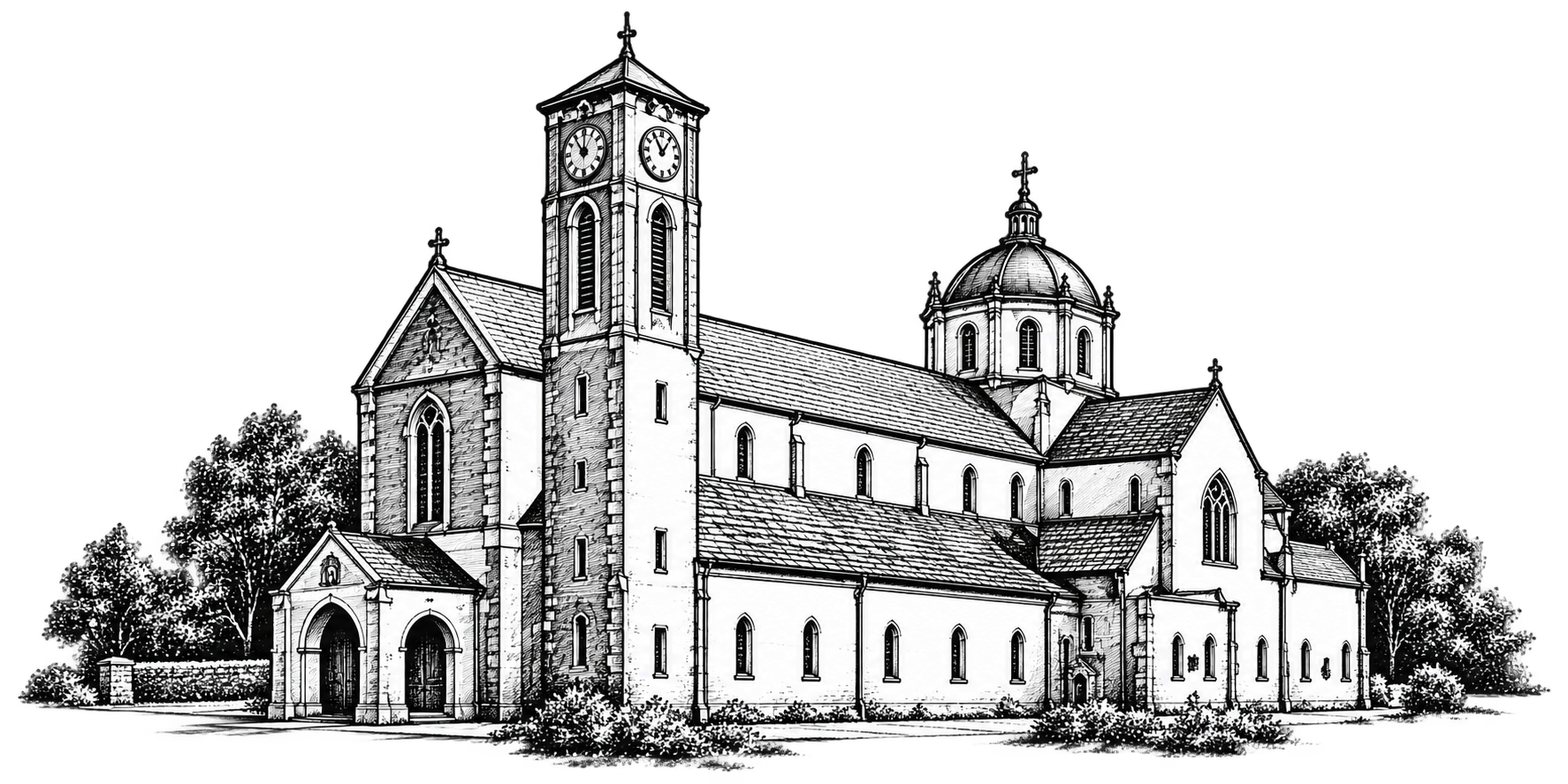
Situated on Barracks Hill, the Church of the Sacred Heart dominates the landscape and can be seen from the approach roads entering Carndonagh.
The Building of a Landmark
Fr Quinn built the earlier chapel, which served the parish community for more than a century.
Fr Daniel Reid, PP, a native of Ballinascreen (1878–1940), initiated a parish fundraising programme. The site for the new church was donated to him.
The Church of the Sacred Heart was dedicated by Bishop Neil Farren, who had accepted a construction tender of £60,866. This included a separate quotation of £4,966 for the tower but excluded excavation costs.
Despite wartime shortages, the church opened with Fr James Bonner of Killygordon (1889–1981) as parish priest. He oversaw construction and faithfully served as parish priest for thirty-three years.
A major refurbishment took place under Fr Séamus Farrelly (1936–2008), in keeping with modern liturgy and adding colour and spiritual ambience for a congregation of over 1,600 worshippers.
Architects & Craftsmen
The original architect was Ralph Henry Byrne, with Murphy Brothers of Castlewood Avenue, Rathmines, Dublin, acting as general contractors. For the 1998 refurbishment, John Masterson of M.H. Associates acted as architect, with John Hegarty of Buncrana as principal contractor, assisted by local craftsmen.
The leaded lights and windows were created at the stained-glass studios of A.W. Lyons, Westland Row, Dublin. John Smyth and Sons supplied the sanctuary lamp and tabernacle. The bells and tower clock were installed by the world-famous Croydon company Gillett and Johnston, established in 1844.
Architecture of Distinction
Built in Romanesque style, the exterior is faced with squared Wicklow granite and is cruciform in design. The building has an impressive tower and a dome surmounted by a cupola, crowned with a twelve-foot bronze cross.
The visitor enters through the ornamental porch and narthex, displaying four nineteenth-century carved stone panels thought to be the work of Italian craftsmen. From the nave, two lines of symmetrical Dublin granite columns, topped with carved capitals, form a graceful round-arched arcade.
Above, the lancet clerestory contains antique, handmade, coloured Norman slab glass. The sanctuary is divided by a decorative wrought-iron screen designed by local craftsmen, while the sanctuary floor is made from granite sourced at Glen, Carrigart.
At the Heart of the Sanctuary
A relic of St Oliver Plunkett lies beneath the altar. The baptismal font to the west was donated by the Simpson family, while the oak chair features a decorated brass inset.
Treasures of the Sacred Heart
Throughout the church, sculpture, stained glass, sacred furnishings and works of art tell the story of generations of faith and craftsmanship.
The Four Statues
Four granite statues, each over eight feet high and weighing four tons, adorn the drum of the exterior dome. Depicting St Patrick, St Brigid, St Colmcille and the Sacred Heart, they are the work of Albert Power (1881–1945), the noted Celtic Revival sculptor and pupil of Oliver Sheppard (1865–1941), creator of the iconic Cúchulainn sculpture in Dublin’s GPO.
Stations of the Cross
Rendered in the style of traditional ecclesiastical painting by an unknown artist, the Stations were brought to Carndonagh by Fr Philip O’Doherty, MRIA (1851–1927), a noted historian who built the Colgan Hall. They are believed to have been sourced in Italy.
Portrait of John Colgan (1592–1658)
Painted by Sr Aloysius, the portrait can be seen to the east of the altar. A native of the area, Colgan joined the Franciscans in 1620, lectured in Aachen and Mainz, and became head of the Louvain School of History. He later served as Commissary of the three Irish Franciscan colleges at Louvain, Prague and Wieluń.
He wrote the Acta Sanctorum Hiberniae, a history of the saints of Ireland, of which only the volume covering January to March was published before his death. He also wrote Triadis Thaumaturgae, a Latin account of Ireland’s three patron saints: Patrick, Brigid and Colmcille.
The Two Altars
The front altar is made of Portland stone. At the rear of the sanctuary, above a section of the original marble high altar, a triptych is formed from three restored nineteenth-century stained-glass windows from the old church, featuring symbols of the Four Evangelists. Part of the marble-topped altar rail of Caen stone remains before the side altars. Mrs W. J. O’Doherty presented the altar rails.
The Tabernacle & Sanctuary
The tabernacle was donated by the Lanigan family, whose shop was demolished to provide a pedestrian entrance from the Diamond. Six acrylic panels by Derry artist Mary Kelly adorn the shrine of St Anthony, while appliqué tapestries bring colour to the sanctuary.
The candelabra is made of burnished brass, and the sanctuary lamp was donated by the Doherty family of Tiernaleague. Elizabeth Keenan Ryan designed the gilded bronze sanctuary cross. A wooden cross hewn from Magheramore bog oak has been carbon-dated to 3500 BC.
The Church Organ
A Johannus Rembrandt 3000 three-manual organ was installed in 2000. Vera Butler (1910–2011) served as musical director for over sixty years. May she rest in peace.
The Colgan Hall
Situated just below the church, the Colgan Hall was built in 1914 in memory of John Colgan. Its architect was W. J. O’Doherty. Today it serves as a community resource centre.
The Crucifixion Shrine
Dating from the late nineteenth century, the Crucifixion Shrine in the sanctuary was donated by the local Sisters of Mercy and contains brass symbols of the Crucifixion. On its reverse is a Latin inscription dating from the time of Pope Leo XIII.
The Sisters also donated the statues near the sanctuary. Marble panels on the sanctuary pillars came from the original pulpit, while the decorative artwork was created by Art Glass, Derry.
Places of Historic Interest
The heritage of Carndonagh extends beyond the church itself, with remarkable early Christian monuments and places of worship nearby.
The Carndonagh Cross
Dating from the seventh century, the Carndonagh Cross is regarded as Ireland’s first free-standing cross. Situated approximately half a kilometre from the Church of the Sacred Heart, it features a Crucifixion scene.
Four pillar stones depict a fish symbol, a harp, St David, and a bishop holding a book, crozier and bell. The bell recalls the ancient Donagh Bell, acquired by the Royal Irish Academy and later the National Museum.
The Marigold Stone can be seen in the graveyard. Other monastic sites can be visited at Cloncha and Carrowmore, near Culdaff.
The Mass Rock
Less than one kilometre from the Carndonagh Cross, the old Mass Rock can be found off the Ballyliffin Road. Mass was celebrated in this ancient woodland during Penal times.
The white cross on top of the altar stone came from the old church, preserving a tangible link with earlier generations of worshippers.